
Embroidery Tips
How to Choose the Right Needle Size for Your Embroidery Machine
May
Choosing the right needle size is one of those details that quietly makes or breaks an embroidery job. The wrong needle leads to thread breaks, fabric damage, and uneven stitching. Here’s a practical guide to getting it right — start with your machine’s requirements, then use this as your reference.
What Is an Embroidery Machine Needle?
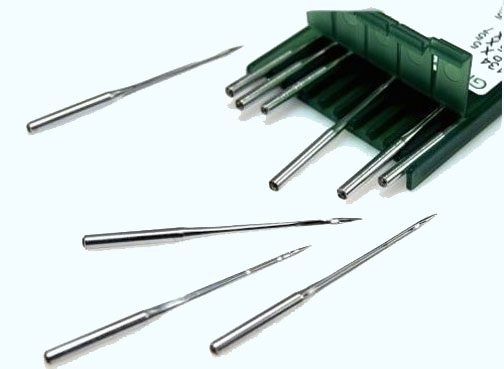
Embroidery machine needles are purpose-built for embroidery machines and work with rayon and polyester embroidery threads. Compared to universal needles, they have a deeper scarf at the front, a larger eye, and a rounded point that protects thread from shredding and breaking.
Embroidery Needles vs. Standard Sewing Needles
Two main differences set them apart:
- Larger eye — embroidery needle eyes are bigger than standard sewing needle eyes, reducing friction on the thread.
- Deeper scarf and rounded point — this protects the thread and helps it pass cleanly through fabric.
Sharp Needles vs. Ball Point Needles
The point type matters as much as the size:
- Sharp needles — best for woven fabrics and tightly constructed materials. They also handle some loosely woven fabrics well.
- Ball point needles — designed for knits and stretch fabrics. The rounded tip slips between fibers instead of piercing them, preventing runs and snags.
How Embroidery Needles Are Sized
Needle size refers to the diameter of the needle’s blade. A size 75/11 needle has a 0.75 mm blade diameter. The two numbers are the same measurement in two systems — 75 is the metric (EU) standard, 11 is the Singer (US) standard:
| Metric (EU) | 65 | 70 | 75 | 80 | 85 | 90 | 95 | 100 |
|---|---|---|---|---|---|---|---|---|
| Singer (US) | 9 | 10 | 11 | 12 | 13 | 14 | 15 | 16 |
The Three Sizes You’ll Use Most
We stock embroidery needles in 65/9, 70/10, 75/11, 80/12, and 90/14. For most shops, three sizes cover the vast majority of jobs:
- 65/9 — small detail work, sharp curves, and high-density designs.
- 75/11 — the workhorse. You’ll use this 70–80% of the time. Big enough for clean embroidery, strong enough to hold up.
- 80/12 — heavier fabrics like denim, canvas, and structured materials.
Needle Size by Fabric Type
A quick reference for matching needle to material:
| Fabric | Needle Size | Point Type |
|---|---|---|
| Golf shirt (knit) | 70/10–80/12 | Ball point |
| Lace | 75/11 | Sharp point |
| Leather | 80/12 | Sharp or wedge point |
| Lingerie & silk | 60/8–75/11 | Sharp or light ball point |
| Lycra / spandex | 70/10–80/12 | Medium ball point |
| Nylon windbreaker | 70/10–80/12 | Light ball point |
| Organza | 65/9 | Ball point |
| Rayon | 75/11 | Ball point |
| Satin jacket | 75/11 | Sharp point |
| Sweater / sweatshirt | 70/10–80/12 | Light ball point |
| Taffeta | 65/9 | Ball point |
| Terry cloth towels | 75/11 | Sharp or ball point |
| Velvet | 65/9 | Ball point |
| Vinyl | 75/11 | Sharp point |
When to Replace Your Needles
Needle life depends on how much you run and what you stitch. As a rule of thumb, replace embroidery needles every 50,000–60,000 stitches to keep quality consistent and your machine running smoothly. And if a needle starts to sound or feel off mid-job — replace it immediately. A worn needle will cost you far more in ruined garments than a fresh one costs to swap in.
Where to Buy Embroidery Needles
If sourcing the right needles has been a hassle, we can help. Browse our embroidery machine parts and needles, or contact us with your machine model and the fabrics you work with — we’ll point you to the right sizes.

The needle reference chart you provided will be a lifesaver. I never know what size use. Thanks for the great info!
Thanks for your comments. Glad that it helps.
I love your web site . your prices are great will save me a lot of money